The Search That Happens 40 Times a Day in Your City
Right now, someone two miles from your shop is sitting in a parking lot with a check engine light on. They opened Google and typed "auto repair shop near me." Within three seconds, they are looking at a map with three businesses pinned on it. They are going to call one of those three. They are not going to scroll further. They are not going to search again with a different phrase. They will pick one of those three, get someone on the phone, and bring their car in.
If your shop is not in those three spots, that customer does not know you exist. Not because your shop is worse. Not because your prices are higher. Simply because Google decided someone else deserved that spot more than you did, and you never told Google otherwise.
This search happens 40 to 80 times every day in a mid-sized city. Oil changes, transmission jobs, brake replacements, engine diagnostics. People search, three shops appear, one shop gets the call. The two shops that did not appear got nothing.
What Auto Repair Shop Invisibility on Google Actually Costs You Every Month
Let's put real numbers to this because shop owners often underestimate how big the problem is.
The average auto repair ticket in the United States runs between $350 and $600 depending on service mix. Shops ranking in the top 3 on Google Maps in a typical metro area receive 40 to 80 inbound calls per day. Shops buried below the Map Pack, or not appearing at all, receive 5 to 10 calls per day, almost entirely from existing customers or word of mouth.
That gap, roughly 35 to 65 calls per day from new customers who found competitors instead of you, is where the revenue disappears. At a 55 percent close rate and a $400 average ticket, 35 missed calls per day equals $7,700 in daily revenue walking out the door. Over a 30-day month, that is $231,000 in potential revenue your shop never sees.
Even on the conservative end, shops capturing just 10 additional customers per day from Google Maps at $400 per ticket are generating $120,000 per month that invisible shops cannot access. The $20,000 to $30,000 figure is not a stretch. For most auto repair operations, it is a floor, not a ceiling.
Why Your Auto Repair Shop Is Not Showing Up on Google Maps
Google Maps rankings are not random. There is a specific set of signals Google evaluates before deciding which three shops appear for any given search. Most auto repair shops fail on the same three or four signals every time.
Unclaimed or incomplete Google Business Profile. A Google Business Profile that is missing hours, services, photos, or a description is a shop Google does not trust enough to recommend. Google is making a referral on behalf of its users. It will not refer a business it cannot confidently describe. If your profile has no photos, lists no services, or has not been touched in months, Google treats you as a low-confidence option.
No recent reviews, or reviews that went stale. A shop with 47 reviews and the most recent one from two years ago looks, to Google, like a shop that may no longer be operating or has declined in quality. Google weights recency heavily. A shop with 30 reviews and a consistent flow of new ones every month outranks a shop with 200 reviews and nothing posted in the past year.
Inconsistent business information across the web. Your business name, address, and phone number need to match exactly across Google, Yelp, Facebook, your website, and every directory listing that references your shop. A single digit transposed in your phone number or a slightly different version of your business name is enough to introduce doubt in Google's systems. Doubt drops rankings.
A website that does not speak Google's language. If your website does not clearly state what you do and where you do it, Google cannot confidently connect your business to local searches. Pages that mention "oil changes in Atlanta" or "transmission repair in Lawrenceville" tell Google exactly who should be finding your business. A generic website with no location context leaves Google guessing.
The Three Ranking Signals That Determine Auto Repair Shop SEO
Google evaluates local businesses on three axes: proximity, relevance, and prominence. Understanding how each works for auto repair shops tells you exactly where to focus.
Proximity is how close your shop is to the person searching. You cannot move your building. This signal is fixed. But proximity only matters when the other two signals are strong enough to bring you into contention. A shop 0.3 miles from the searcher with a weak profile still loses to a shop 1.5 miles away with a strong one.
Relevance is how clearly your listing and website describe what you do. Google needs to understand that you perform oil changes, brake inspections, transmission repairs, wheel alignments, and engine diagnostics, not just that you are an "auto repair shop." The more specifically and consistently you describe your services, the more searches you become relevant for. Relevance is built through your Google Business Profile service list, your website page structure, and the language you use across both.
Prominence is the most misunderstood and the most controllable. It is Google's measure of how reputable and established your business is. Review count, review recency, review responses, backlinks from local websites, citations in directories, and your website's overall authority all feed into prominence. This is where most auto repair shops have the largest gap, and closing that gap is what moves you into the top 3.
How Scheduling Software Connects to Your Google Map Pack Ranking
This is a connection most shop owners have never been told about, and it matters more than most SEO tactics.
Google Business Profiles that have an active booking link, connected to a scheduling system, earn a "Book Online" button directly in the search results. Customers can schedule a service without even clicking through to your website. That frictionless experience increases the rate at which searchers convert to actual appointments, and Google measures that conversion rate. A profile that generates more bookings relative to how often it appears in results gets rewarded with better rankings.
Beyond the direct booking signal, scheduling software creates a second major advantage: automated review collection. When a customer checks out, a well-configured scheduling system sends a text message or email 24 hours later asking for a Google review. Shops using this workflow consistently generate 8 to 15 new reviews per month without anyone on staff having to remember to ask. That steady flow of fresh reviews is one of the strongest prominence signals in auto repair shop SEO.
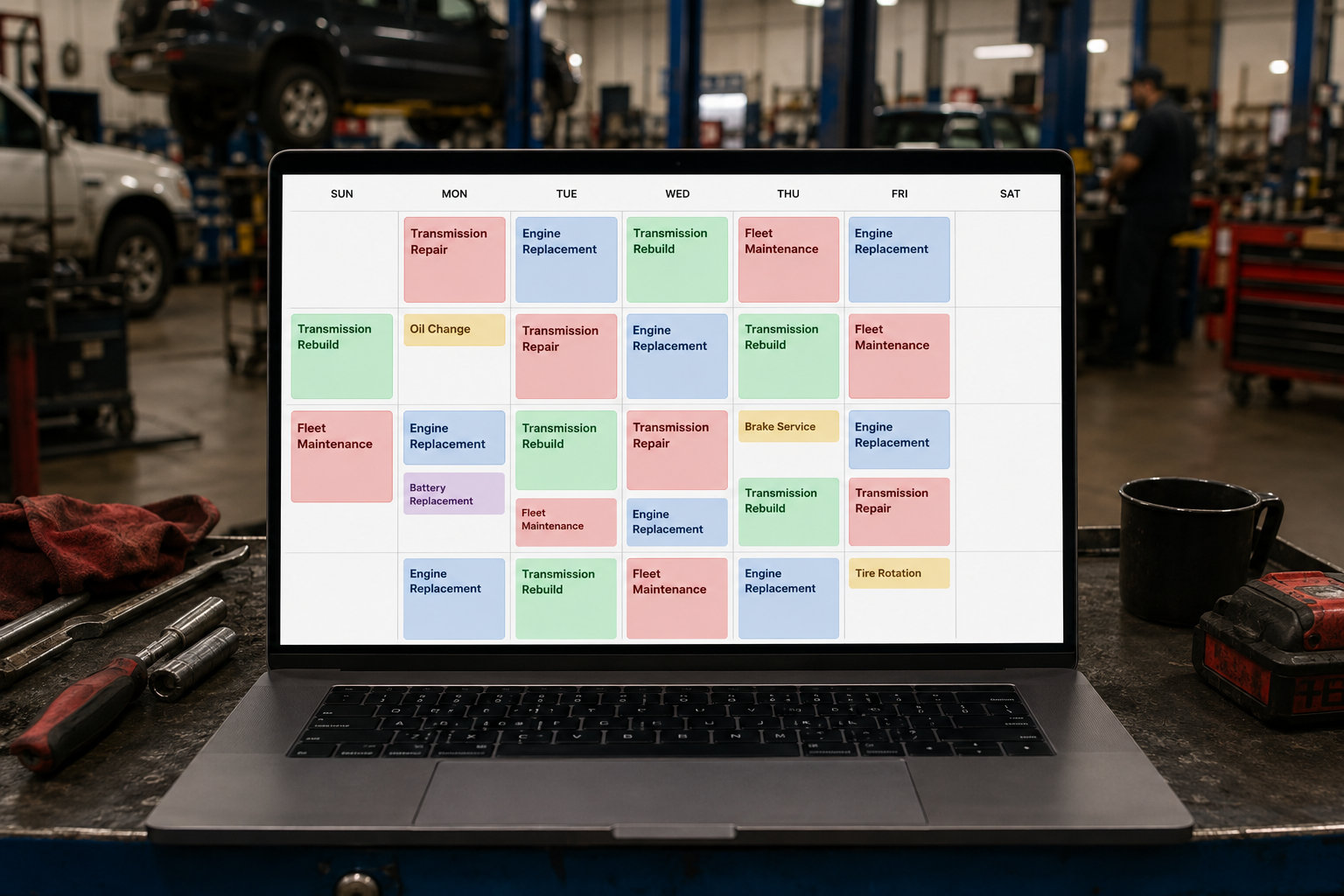
The image at the top of this post shows exactly what a well-organized scheduling system looks like for an active shop: every bay accounted for, every appointment tracked, every service categorized. That level of operational clarity does not just make the shop run better. It creates the data trail that powers Google ranking: confirmed appointments, completed jobs, and post-service review requests sent automatically.
What Winning the Google Map Pack Looks Like for an Auto Repair Shop
Shops that break into the top 3 on Google Maps describe the same experience. The phone starts ringing differently. Instead of five or six calls a day from regulars, they get 30, 40, 50 calls from people they have never spoken to, asking about oil changes, asking about brake jobs, asking how fast they can get in. The question stops being "how do we find more customers" and becomes "how do we keep up with this volume."
Shops in strong Map Pack positions stop running discounts and coupons because they do not need to compete on price. Demand exceeds capacity. The referral network that used to feel like the only marketing that worked becomes one channel among several, instead of the only one.
The shops reaching this position are not doing anything magical. They have a complete, active Google Business Profile. They have a consistent flow of new reviews. Their website is built to tell Google what they do and where they do it. They are listed correctly across local directories. And in many cases, they are using scheduling software that generates review requests automatically and keeps their booking signal active.
None of it is complicated. The gap between the shop that shows up and the shop that does not is almost never about quality of work. It is about which shop made it easy for Google to trust them.
If you want to understand exactly where your shop stands and what it would take to move into the top 3 in your area, start with a full audit of your Google Business Profile and review history. Our complete guide to ranking on Google Maps in 2026 walks through every signal in detail and gives you a checklist you can work through this week. Or reach out directly and we will do the audit for you at no cost.