The Core Problem with Most Service Business Websites in Atlanta
The website looks professional. The photos are good. The service list is complete. The "About Us" page tells a genuine story. And yet — the phone doesn't ring from the website. Google Ads are running, traffic is coming in, and the conversion rate is 1% or lower.
This is one of the most common situations we encounter with Atlanta and Gwinnett County service businesses. The traffic problem has been solved. The conversion problem hasn't. And the two are entirely separate problems with entirely different solutions. A landing page that converts 5% of visitors instead of 1% doesn't just feel better — it makes every dollar of ad spend five times more effective. That arithmetic is why landing page design for service businesses has become one of the highest-ROI investments a growing Atlanta business can make.
What a High-Converting Landing Page Actually Does
A landing page has one job: get the visitor to take the next step — call, book, or submit a form. Everything on the page should serve that single goal. The mistake most service business websites make is trying to do too much: tell the company story, list every service, display a gallery, feature the team, link to the blog, and show the contact form somewhere near the bottom. Each of those elements competes with the conversion action. Each one gives the visitor something to do besides call you.
High-converting landing pages for service businesses are ruthlessly focused. They answer three questions fast — what you do, where you do it, and why a customer should pick you — and then they make it as easy as possible to take action. That's the entire framework. The execution of that framework is where most businesses fail.
The 7 Landing Page Mistakes Killing Atlanta Service Business Conversion Rates
1. The Phone Number Is Not Visible on Mobile Without Scrolling
More than 70% of local service searches in Atlanta happen on mobile phones. When someone lands on your website from a Google search or a Google Ad, they are often on a phone, often in an active need situation, and often making a decision in 15 seconds or less. If your phone number is not clickable and visible in the top of the screen on mobile — without scrolling — you're losing a significant percentage of those visitors before they ever see anything else on your page.
We've audited service business websites across Gwinnett County and Atlanta where the phone number is only in the footer, or appears as plain text rather than a clickable tel: link. Fixing this single issue — moving a clickable phone number into the mobile header — has produced measurable call volume increases for multiple clients without any other changes to the page.
2. The Headline Talks About the Company, Not the Customer
"Atlanta's Premier HVAC Solutions Since 1997" is a company statement. "AC Broken? We're in Gwinnett. Same-Day Repair." is a customer statement. The difference in conversion rate between those two headlines is not subtle. The first one asks the visitor to care about your history. The second one answers the question the visitor came to the page with.
High-converting headlines for service business landing pages do three things: identify the service, confirm the location, and address the urgency or desire the customer arrived with. For an emergency service like plumbing or HVAC, urgency is the primary driver. For a planned service like landscaping or remodeling, desire and trust are the primary drivers. The headline needs to match the mode the customer is in, not the self-image the company wants to project.
3. Page Load Speed on Mobile Is Slow
Google's Core Web Vitals data consistently shows that service business websites in Atlanta lose a significant percentage of mobile visitors before the page fully loads. Every additional second of load time reduces conversion rate. A page that takes 4 seconds to load on a mobile connection will convert at a lower rate than the same page loading in 1.5 seconds — sometimes dramatically lower, particularly for high-urgency service searches where the visitor has other tabs open with competitors.
The most common causes of slow mobile load times on service business sites: unoptimized images (the single biggest culprit), page builder-generated code bloat, render-blocking scripts, and uncompressed video backgrounds. A site built with clean, purpose-written code and properly sized images consistently outperforms a site built on a page builder template on these metrics — and that performance gap directly translates into higher conversion rates.
4. No Trust Signals Above the Fold
In a competitive Atlanta market, a visitor who has never heard of your company needs a reason to believe you're legitimate before they'll call. That reason needs to appear before they scroll. License numbers, insurance badges, years in business, star rating from Google reviews, number of completed jobs — any of these, displayed prominently in the header or hero section, reduce the friction between landing and calling.
Most service business websites either don't have these trust signals at all, or have them buried on an "About" page that 80% of visitors never reach. On a high-converting landing page, trust signals are part of the above-the-fold design — not an afterthought.
5. Too Many Calls to Action Competing with Each Other
"Call Now" and "Get a Free Quote" and "Schedule Service" and "View Our Gallery" and "Read Our Blog" — every time you give a visitor a new choice, you reduce the probability they'll take any of them. This is not a theory; it's a documented psychological principle called decision fatigue. The more options a page presents, the lower the conversion rate on any individual option.
A high-converting service business landing page has one primary CTA — almost always a phone number or a short contact form — and everything else on the page supports that single action. Secondary information (service details, testimonials, service area) exists to build confidence before the CTA, not to provide alternative paths away from it.
6. The Page Doesn't Match the Ad That Sent the Visitor There
If an Atlanta homeowner clicks a Google Ad for "emergency AC repair Gwinnett County" and lands on a homepage that talks about all of your HVAC services without specifically addressing emergency repair — the message mismatch creates confusion. Confused visitors don't convert; they bounce and call a competitor whose page matches what they were looking for.
Dedicated landing pages that match specific ad campaigns consistently outperform general homepages as ad destinations by significant margins. For most service businesses running Google Ads in Atlanta, this is one of the highest-leverage changes available: don't change the ad, change where it lands.
7. The Form Asks for Too Much Information
A contact form with 8 fields — name, address, service type, preferred date, preferred time, how did you hear about us, describe your problem, attach a photo — is not a form designed to generate leads. It's a form designed to feel thorough. Every additional field reduces form submission rate. For most service business landing pages, a form with 3 fields — name, phone, and a brief description — consistently outperforms a detailed form by a significant margin. You can get the additional information when you call them back.
What a High-Converting Service Business Landing Page Looks Like in Practice
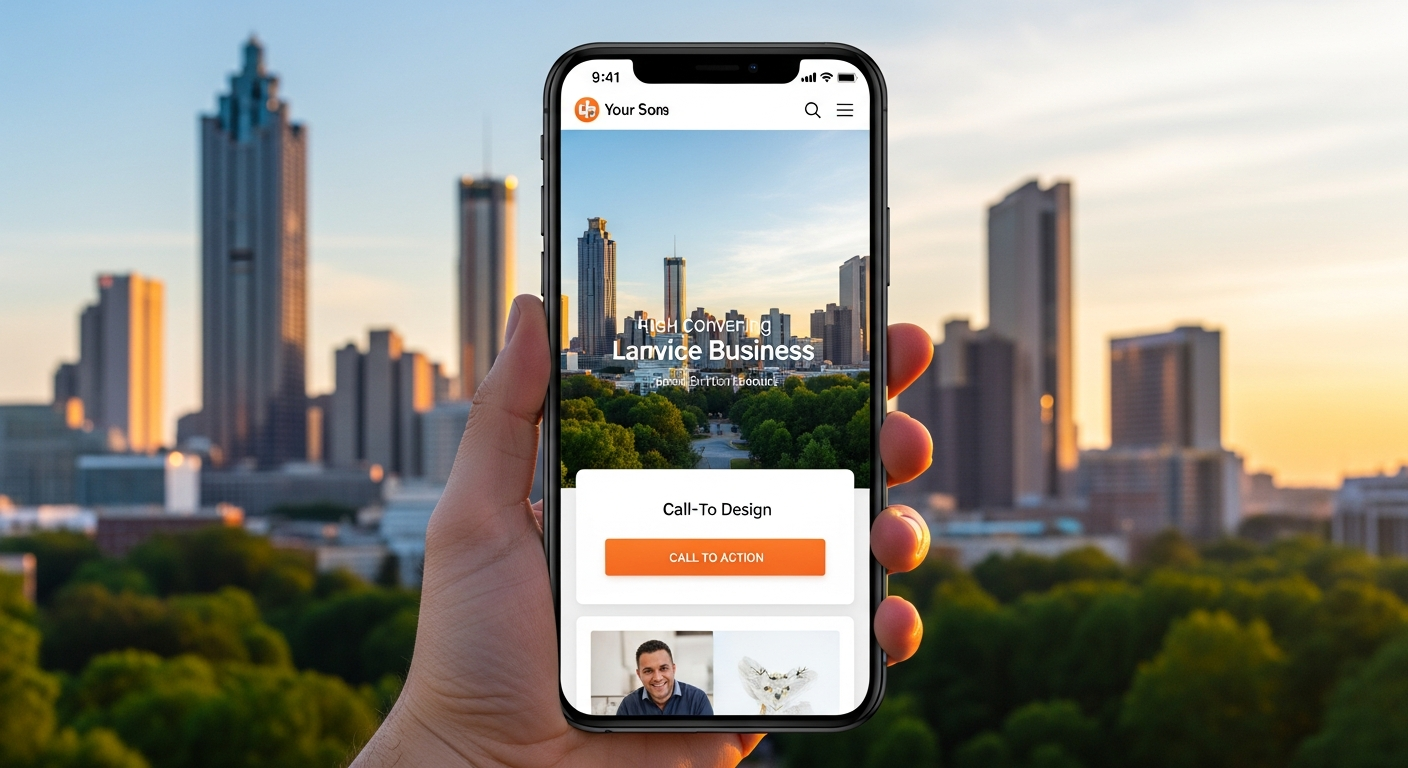
For an HVAC company in Lawrenceville running Google Ads on emergency repair keywords, a high-converting landing page looks like this: clickable phone number in the header of the mobile view, headline that reads something like "AC Not Cooling? We're in Gwinnett — Same-Day Service," a subheadline with a trust signal (licensed, insured, 4.9 stars from 110 reviews), a short 3-field form with a "Get Help Now" submit button, three brief trust points (licensed, 24/7 availability, same-day service), and a short paragraph about service areas with city names Google and the visitor both recognize.
That's it. No lengthy "about us" copy. No gallery carousel. No blog link. One job, one focus, one conversion goal. That structure is what consistently produces the conversion rates that make Google Ads profitable for service businesses — and what makes the SEO traffic from a city page into actual calls, not just analytics numbers.
Mobile-First is Not Optional for Atlanta Service Business Landing Pages
Custom responsive web design for Atlanta service businesses in 2026 means mobile-first by default — not mobile-accommodating. A page designed for desktop and then adapted for mobile almost always has compromises: buttons that are slightly too small, text that's slightly too compressed, layouts that technically fit on a phone but don't feel right. A page designed for the phone screen first, then expanded to desktop, is almost always cleaner, faster, and more intuitive on the device that the majority of your potential customers will use to find you.
For service businesses in Gwinnett County and Atlanta who are investing in Google Ads, local SEO, or any other traffic source, the landing page is the last step between that investment and a paying customer. Getting it right isn't a design preference — it's the difference between a marketing budget that pays for itself and one that doesn't.
Frequently Asked Questions
A high-converting service business landing page has a clear headline stating what you do and where, a visible clickable phone number above the fold on mobile, trust signals like reviews and licenses within the first screen, mobile load time under 3 seconds, and a single primary call to action. The most common conversion killers are slow load speed, buried phone numbers, and headlines that talk about the company instead of addressing the customer's situation.
A custom, high-converting landing page for a service business in Atlanta typically ranges from $800 to $2,500 depending on complexity. Page builder templates cost less upfront but often underperform on speed and mobile experience — which directly affects the ROI of any paid traffic sent to the page. The cost of a page that doesn't convert is measured in ad spend wasted, not in what the page itself cost.
Yes, for most service businesses running Google Ads in Atlanta. A dedicated landing page that exactly matches the ad's message converts significantly better than sending ad traffic to your homepage. A homepage is designed for multiple audiences and purposes. A landing page is designed for one specific intent — and that specificity is what produces the conversion rate that makes Google Ads profitable rather than just expensive.
Yes. We design and build custom, mobile-first landing pages and full websites for service businesses across Atlanta, Dacula, and Lawrenceville. Every page is built around the specific conversion goal, the specific service, and the specific local market. No page builder templates — clean, fast, custom code built to convert the traffic you're already paying to send. Contact us for a free audit of your current site's conversion rate.