
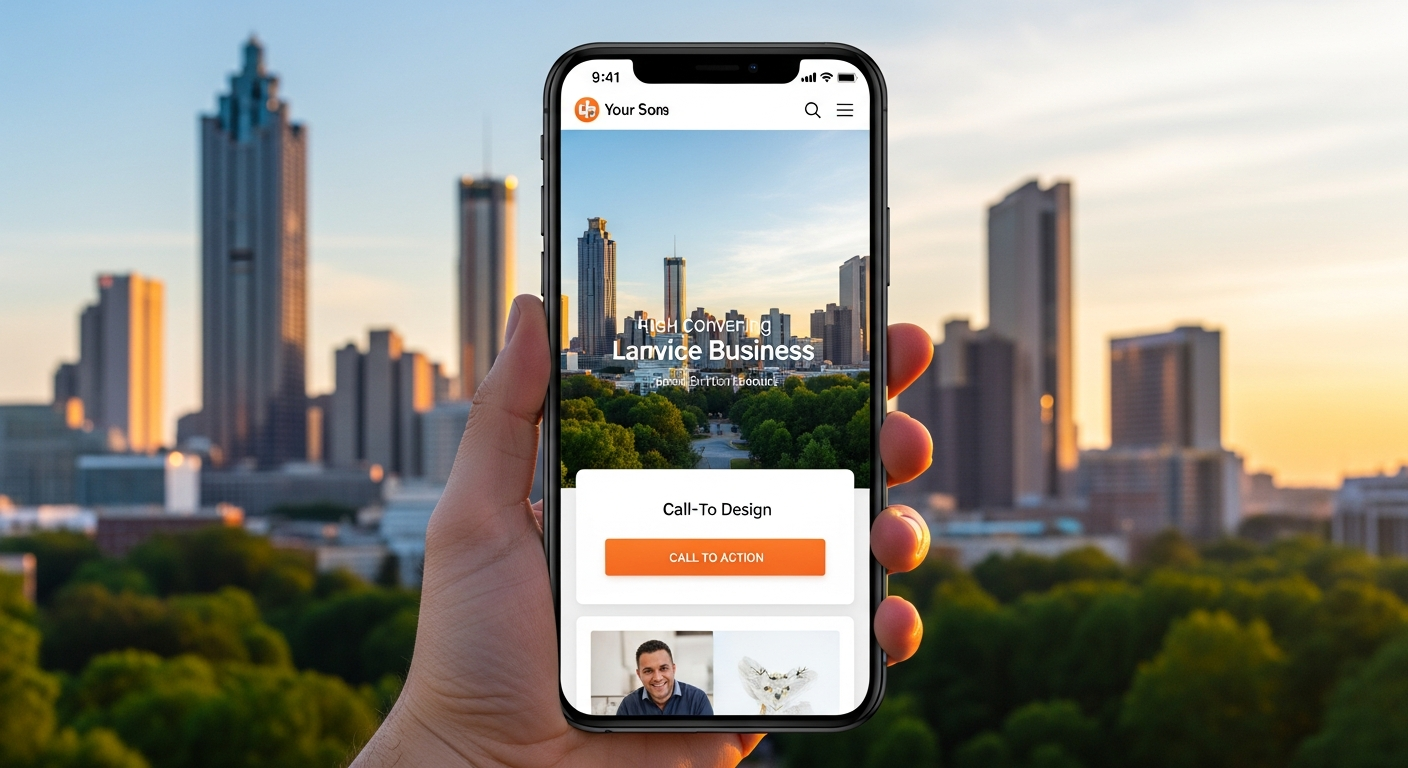
The Above-the-Fold Section Is Doing All the Work
The first screenful of your website before any scrolling is the single most important real estate on your entire site. This is what visitors see in the first three seconds, and those three seconds determine whether they stay or leave. A high-converting service business website uses that space to accomplish three things immediately: establish what the business does and where, show at least one trust signal, and make the contact action obvious.
Specifically, the above-the-fold section of a converting service business website includes: a headline that names the service and city, a phone number in the top right corner, a short contact form or click-to-call button, Google review stars if available, and at least one real photo showing the work or the team. That is the complete formula. Any site missing two or more of these elements is leaving leads on the table.
What a high-converting above-the-fold section does NOT include: a rotating image slider, a video with autoplay audio, vague inspirational text, a hero image of a stock handshake, or a navigation with more than six items. All of these slow load time, distract from the call to action, or reduce trust.
The Headline Speaks to the Customer's Problem, Not the Business's Pride
A weak website headline talks about the business. "Family-Owned Since 1989." "Your Trusted Partner in Home Services." "Excellence in Every Job We Do." These headlines are about the company and they convert poorly because visitors do not come to your website to hear about your history or your values. They come because they have a problem they need solved right now.
A strong headline leads with the customer's outcome or the customer's problem. "AC Broken in Atlanta? Same-Day HVAC Service Available." "Lawn Care in Lawrenceville and Gwinnett County. Free Estimates, Weekly Service." "Roof Replacement in Dacula GA. Licensed, Insured, and On the Google Map Pack."
Notice that all three of these headline examples name the service, name the location, and include a secondary point of differentiation. That is the structure that converts. The visitor reads it and knows immediately that they are in the right place.
Real Photos Convert Better Than Stock Photography Every Time
Stock photography is the fastest way to signal to a visitor that they are looking at a generic business rather than a real local company with real people. When someone in Gwinnett County is searching for a plumber, they are already filtering for local. A photo of a smiling stock model in a hard hat does not build trust with that visitor. A photo of your actual technician standing in front of your van with your phone number on the door does.
Real photos of completed work are even more effective than team photos for conversion. Before and after photos for cleaning, landscaping, remodeling, or detailing businesses are among the highest-converting pieces of content a service business website can have. They answer the visitor's most important question, which is whether you actually do what you claim to do, better than any paragraph of text.
If you do not have professional photos, a well-lit smartphone photo of a completed job is still better than stock photography. The authenticity of real work always outperforms the polish of fake work.
The Mobile Experience Is the Primary Experience
In 2026, designing a website for desktop first is designing it for the minority of your visitors. For most local service businesses in Atlanta, Orlando, and Tampa, more than 70 percent of website traffic comes from mobile devices. A site that is hard to navigate, slow to load, or requires pinching and zooming on mobile is not a functional business asset. It is a broken one.
The elements of a high-converting mobile experience are specific. The phone number is in the top right and large enough to tap with a thumb. The contact form is visible without scrolling. The text is large enough to read without zooming. The navigation does not require a mouse to use. The site loads in under three seconds on a 4G connection. None of these are aesthetic considerations. They are functional requirements that directly determine whether a visitor calls you or calls your competitor.
A website is not a digital brochure. It is the salesperson who works 24 hours a day, 7 days a week, and either closes the lead or sends it to your competitor. Design it accordingly.
Reviews Are Visible Where the Decision Happens
Google reviews are the most powerful trust signal a local service business has. They are also almost universally buried at the bottom of service business websites where no one sees them before making a contact decision. A high-converting service business website puts the review count and star rating in the header, directly below the headline, or in the first content block after the hero section.
For a service business with 20 or more Google reviews at 4.5 stars or higher, displaying those reviews prominently is the single fastest way to increase conversion rate without changing anything else about the site. Visitors who see social proof from real customers within the first few seconds of landing are dramatically more likely to contact you than visitors who see the same site without that signal.
If you want to see what this looks like in practice for a real service business, read the case study on how Evering Cleaning Services went from inconsistent bookings to fully booked after rebuilding their website around these principles.
Frequently Asked Questions
The highest-converting service business websites in 2026 have a specific headline naming the service and location, a phone number visible in the top right of every page, real photos of completed work, Google review stars above the fold, and a short contact form. Sites with all five consistently convert at 4 to 6 percent versus the industry average of 1 to 2 percent.
Mobile design is the most important design consideration in 2026. More than 70 percent of local service searches happen on mobile, and Google ranks websites based on their mobile version first. A website that looks great on desktop but loads slowly on mobile is losing the majority of its potential leads.
Yes, but only if the content is genuinely useful and locally targeted. Blog posts answering specific local questions rank in Google and drive targeted traffic. Generic blog content without location specificity adds very little SEO value for local service businesses.